Located approximately 4 to 5 hours west of Espanola and equal distance south of Santa Cruz, this island has long been a favorite site of visitors including pirates, whalers and early settlers.
One of the oldest islands Floreana illustrates the aging process of a volcanic island. Unlike the younger western islands, Floreana's volcano has been long extinct and is in the advanced stages of erosion. The erosion process gave the island the nutrients and soils need to sustain plant life. The combination of this rich soil and a good water supply have given the highlands of Floreana a diversified landscaping of native and introduced flora.
Floreana is best known for its colorful history of buccaneers, whalers, convicts, and colonists. In 1793 British whalers established the Post Office Barrel to send letters to and from England. This tradition has continued over the years, and even today visitors may drop off and pick up letters, without stamps, to be carried to far destinations. Punta Cormorant offers two highly contrasting beaches. The landing beach is of volcanic origin and is composed of olivine crystals, giving it a greenish tinge. At the end of the short trail is a carbonate beach of extremely fine white sand. Formed by the erosion of coral skeletons, it is a nesting site for green sea turtles.
In the 1930's Floreana was the setting for intrigue and mystery. A German dentist and his mistress, a young family (the Wittmer family who still live on the island) and a self-styled baroness with three men came to settle in the island. Shortly after the baroness and her lovers arrived chaos began. The baroness and her entourage terrorized the other inhabitants while planning to build a luxury hotel.
Eventually the baroness, two of her lovers and the dentist all turned up missing or dead. There has been much investigation searching for what really happened on Floreana, but there have never been any hard answers. John Treherne wrote of these people in "The Galapagos Affair". Learn more about the mystery from Time Magazine's 1934 article Death in the Galapagos.
This is one of the few visitor sites, that is visited for its human history. Whaling Captain James Colnett established the wooden post barrel in the early 1793. At the time whaling was a big industry, ships were typically gone for 2 years at a time. The Galapagos Islands were a frequent stop for these ships. Outbound ships would drop off letters after rounding the cape and the ships returning home would mail them.
Over the years thousands of ships have stopped to send and receive mail at Post Office Bay. Many have posted a sign of driftwood or other materials memorializing their visit. This is the only area in the Galapagos were graffiti is still acceptable.
Arriving at Post Office Bay you will land on a brown sand beach, passing the sea lions lying in the sun. At the post barrel the guide will pull a hand full of letters for the group. Continuing the tradition, the letters are brought home with the traveler and then mailed to the addressee. Visitors also have the opportunity to send letters of their own.
There is also the remains of a Norwegian Fishing Village a commercial fishing operation established in 1926 and abandoned a couple of years later. The group of Norwegians arrived with dreams of riches started a fishing and can operation on $900 each. The tough Galapagos life and a few misfortunes had them abandon their dreams.
A visit to Post Office Bay is 1 hour walking on the beach to the Post Barrel
| Landing: | Wet landing |
| Highlights: | Sending and delivering post cards via post barrel |
| Conditions: | Gentle beach |
| Notes: | Bring water, good hiking shoes be careful not to walk off trail and disturb nests |
| Activity Level: | Low |
Yellow Warbler
Lava Heron
Striated Heron
Great Blue Heron
Marine Iguana
Lava Lizard
Galapagos Sea Lion
Galapagos Fly Catcher
Brown Pelican
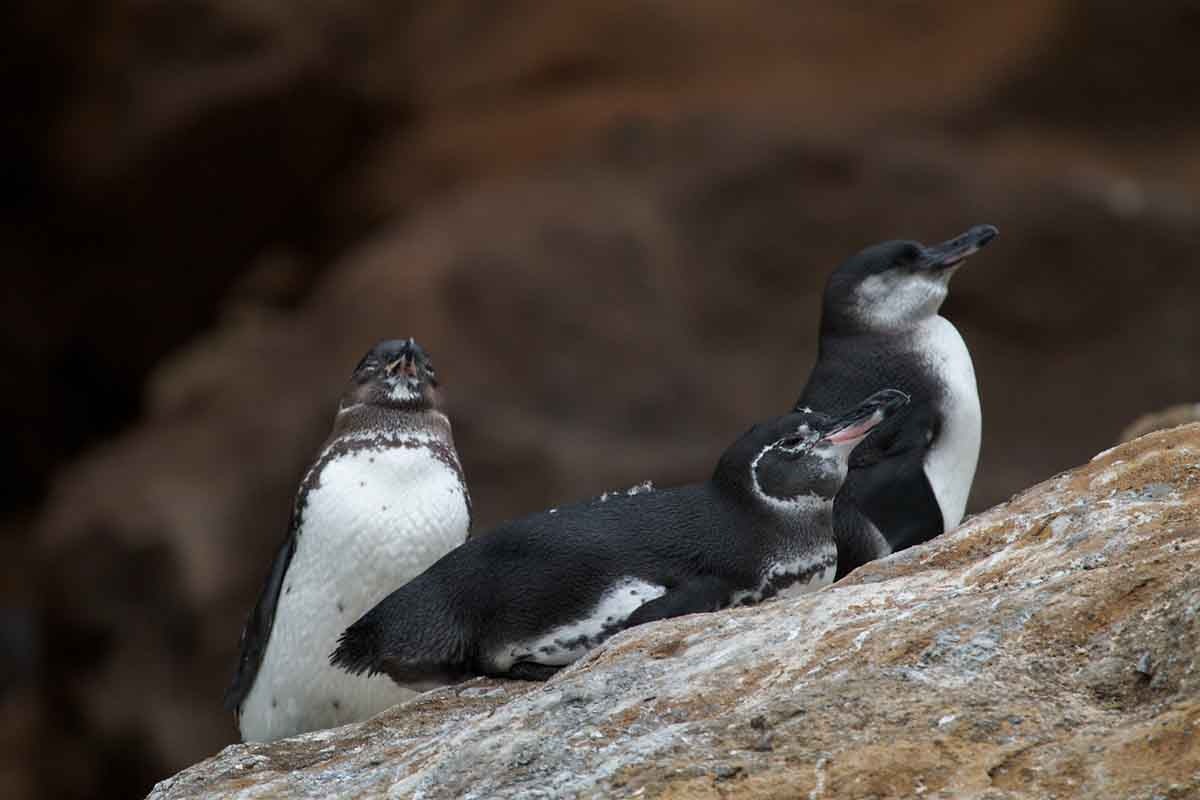
Galapagos Penguin
Warbler Finch
Galapagos Green Sea Turtle
Semi Terrestrial Hermit Crab
Sally Light Foot Crab
The visit to Punta Cormorant offers two contrasting beaches. Arriving on shore you will encounter a green sand beach (the green sand is caused by the olivine crystals derived silicates or magnesium and iron) from here you will follow the trail leading to a lagoon where pink flamingoes and other shore birds can be seen in the distance making their home. Looking into the mud of the lagoon there appears to be 'cracks' in the mud. These cracks are not caused from dryness but are actually the footpaths of flamingos. This is also a good spot for seeing large-billed flycatchers, small-ground finch, medium-ground finch or cactus finch. The walk continues to another beach on the other side made of fine white sand particles known as "Flour Beach". In the waters ghost crabs and rays can be seen swimming.
A visit to Punta Cormorant is a 2 hour walk past the pond over and over a small hill on a sandy trail
| Landing: | Wet Landing |
| Highlights: | Flamingo lagoon, Darwin Finch and Flour Beach |
| Conditions: | Easy trail with open zone on far beach |
| Notes: | Take caution not to disturb sea turtle nests |
| Activity Level: | Moderate to High |
Semipalmated Plover
Greater Flamingo
Lava Heron
Striated Heron
Great Blue Heron
Marine Iguana
Lava Lizard
Galapagos Sea Lion
Galapagos Fly Catcher
White Cheeked Pintail Duck
Brown Pelican
Galapagos Penguin
Black Necked Stilt
Galapagos Green Sea Turtle
Whimbrel
Semi Terrestrial Hermit Crab
Sally Light Foot Crab
Located just off Punta Cormorant this is the best snorkeling in the Galapagos! To see the crown you need to go underwater, an almost completely submerged volcano, which erosion has transformed the cone into a series of jagged peaks creating the "Devil's Crown". The remains of the volcano create a haven for seabirds such as boobies, pelicans and frigates. Red-billed tropical birds can be seen nesting in the crevices.
The highlight of the visit is snorkeling in the center of the crater. You will play with sea lions, while swimming with schools of colorful king angel fish, balloon fish, hawkfish, scrawled filefish, yellowtail grunts, tiger snake eels, white-tipped sharks, eagle rays, amberjacks, wrasses, hammerhead sharks, and sea turtles. The water is a bit rough and the current is strong. The east to west current provides a fun ride as it pushes you through the crown. There is a tube on the western side that you can swim through if you are a strong swimmer (approximately 10-15 feet down) and come out on the other side.
Devil's Crown is a 45 minute snorkeling trips
| Landing: | No landings permitted this is a snorkel and dive site only |
| Highlights: | Snorkeling inside cone with a variety of colorful fish |
| Conditions: | Currents may be strong |
| Notes: | Large sharks may be present |
| Activity Level: | Moderate to High |
Manta Ray
Reef Fish
Galapagos Sea Lion
Blue Footed Booby
Nazca Booby
Brown Pelican
Red Billed Tropic Birds
White-Tipped Reef Sharks
Magnificent Frigate Bird
Galapagos Green Sea Turtle
One of the top snorkel sites in the Galapagos. Visitors to Champion will snorkel with white-tipped reef sharks, Galapagos Penguins, sea turtles, eels and colorful reef fish. Dolphins are frequently seen near shore. This is one of the few places the highly endangered Floreana Mockingbird can be seen.
Champion Islet is a 45 minute snorkeling trips
| Landing: | No landings permitted this is a snorkel and dive site only |
| Highlights: | Exceptional Marine life |
| Conditions: | Currents may be strong |
| Notes: | Floreana Mockingbirds and Sea Turtles may be seen |
| Activity Level: | Moderate to High |
Galapagos Sea Lions
Reef Fish
Nazca Booby
Blue Footed Booby
Swallow Tailed Gull
White-Tipped Reef Sharks
Galapagos Green Sea Turtles
Floreana Mockingbird
In recent years Galapagos Islands hopping itineraries have become popular. With the addition of these "hopping tours" visits to the Floreana Highlands have become a new destination. Visitors arrive to Puerto Valeaco Ibarra the smallest town in Galapagos. From there they take an open-air ranch truck/bus to approximately 30 minutes into the highlands of the islands. Where they can see vistas of the island and the ocean beyond. In the wooded highlands you can see several species of birds including yellow warblers, flycatchers and the medium tree finch, which is endemic to Floreana.
While in Floreana you are able to visit the tortoise corral where several San Cristobal Tortoises, which were brought to Floreana years ago by the Wittmer family, now live. As you continue into the highlands you will visit the area known as Asilo de la Paz. Springs in the highlands were also the source of water for the earliest settlers and the nearby caves provided the first shelters.
The visit to the Floreana Highlands begins with a bus ride to the upper elevations of the islands followed by a 1 hour walk passed a giant tortoise coral, natural springs and farm land.
| Landing: | Dry landing |
| Highlights: | Scalesia forest, birds, tortoises, pirate caves |
| Conditions: | Bumpy road can be dusty |
| Notes: | Wear good walking shoes |
| Activity Level: | Moderate to High |
Diving Floreana
Charles Darwin in Galapagos
Rolf
Wittmer
The Galapagos Affair
Galapagos Goes Wireless
Medium Tree Finch Given Endangered Status
Galapagos Island Based Travel A Short History
Galapagos
Blog

(c) 1999-2012 Galapagos Online LLC all rights reserved
